Brainy Quote of the Day

Showing posts with label Physics and Pop Culture. Show all posts

Thursday, March 15, 2018

Pi Departure...

Poker with Data, Einstein, Hawking, and Sir Isaac Newton on the Holodeck

Filming the scene with Professor Hawking

Images from Star Trek tribute to Professor Hawking

Topics: Physics, Physics and Pop Culture, Star Trek, Stephen Hawking

BBC: World renowned physicist Stephen Hawking has died at the age of 76.

He died peacefully at his home in Cambridge in the early hours of Wednesday, his family said.

The British scientist was famed for his work with black holes and relativity, and wrote several popular science books including A Brief History of Time.

There are a myriad of tributes to Professor Hawking from around the world. It is apropos for him, as well as poetic he passed on Pi Day and Albert Einstein's 139th birthday. Both were extraordinary and complicated men.

Less so than the world we live in, where a former campaign manager in France says to a right wing Le Pen crown to where their racism "as a badge of honor." That the president* he helped a foreign government select for us called the nations on the birth continent of the human species as well as Caribbean nations "s--- hole countries."

We are being pushed inexorably from the Age of Enlightenment into the overbearing arms of our lesser angels. Professor Carl Sagan's "candle in the dark" is being snuffed by bigotry, homophobia, misogyny, xenophobia and every "ism" you can modify a noun with. The Dark Ages were about scientific ignorance as well as emotional and irrational fear. Some of us seem determined that those were our "better days."

He wasn't supposed to live beyond his twenties. Perhaps with something like his pluck and determination, we can beat back fascism as he defied the odds of his own existence.

Perhaps...

BBC: Stephen Hawking: Visionary physicist dies aged 76
Nature: Stephen Hawking (1942–2018)

Friday, June 17, 2016

Felix...

The closest picture I could find that looks a lot like she looked: Mr. Johnnie Walker
Topics: Biology, Physics, Physics and Pop Culture

We named her Felix, and probably should have named her Felicia, but she answered to that name. She was a stray my oldest son fed at our front stoop in Texas. From that point on, we had a cat.

We also had one of the best "mousers" I've ever seen. In four days she once brought four dead field mice to the front door. I used to hear it was a sign of affection, but in reality, Felix was in her own motherly way teaching me how-to mouse for myself (er, thanks). I hid them before my wife saw them all. By the fourth, she gave me a disappointed and disgusted look: "cub, you need to fix your mouse problem!" I remembered and removed the logs in the back of the house, and my rodent problem disappeared. She ruled the roost including our dog, literally terrified our Black Lab that outweighed her by 60 pounds!

Cats are often associated with a sixth sense or mystical powers, the usual go-to explanation we humans give when we don't fully understand a phenomena (see: "The Demon-Haunted World: Science as a Candle in the Dark," by Carl Sagan). This research makes a lot of sense. The article reminded me how much we all miss her. She lived to be 21-years-old, not making the trip from Texas to New York and died peacefully in the very place we found her after quietly mewing and curling up for the last time...on our front stoop. RIP, Ms. Felix.

TOKYO, June 14 (UPI) -- Experiments by researchers at Kyoto University in Japan suggest cats have rudimentary understanding of physics and the principle of cause and effect.

Previous studies have shown cats use their hearing to anticipate the presence of hidden objects. Most recently, researchers tested whether cats could anticipate an object's presence in a box based on the sound made when shaking the box. The researchers also tested whether cats expected an object to fall from a box when it was flipped upside down. The findings were published this week in the journal Animal Cognition.

Abstract
We used an expectancy violation procedure to ask whether cats could use a causal rule to infer the presence of an unseen object on hearing the noise it made inside a container and predict its appearance when the container was turned over. We presented cats with either an object dropping out of an opaque container or no object dropping out (turning-over phase) after producing either a rattling sound by shaking the container with the object inside, or no sound (shaking phase). The cats were then allowed to freely explore the experimental environment (exploration phase). The relation between the sound and the object matched with physical laws in half of the trials (congruent condition) and mismatched in the other half (incongruent condition). Inferring the presence of an unseen object from the noise was predicted to result in longer looking time in the incongruent condition. The prediction was supported by the cats’ behavior during the turning-over phase. The results suggest that cats used a causal-logical understanding of auditory stimuli to predict the appearance of invisible objects. The ecology of cats’ natural hunting style may favor the ability for inference on the basis of sounds.

United Press International: Cats use simple physics to zero in on hiding prey, Brooks Hays

Sunday, August 2, 2015

We, Oligarchy...

Image Source: IMDb
Topics: Democracy, Exceptionalism, Internet, Oligarchy, Republic

We are now days from the first debates of the presidential cycle - The Cycle, NOW with Alex Wagner and the Ed Show cancelled on MSNBC due to executives kowtowing at the arcane Nielsen altar, which worked well when you had only ABC, CBS NBC and a few UHF channels: on-demand television and cable viewing, Net Flicks, Amazon Prime et al and pretty much NO ONE in America working a standard 9 - 5 whereby they can park and watch Walter Cronkite at 6:30 pm has somewhat changed the game for the non-Fox audience that's not older, whiter, more conservative and semi or fully retired. We've been in the throws of reality television since Candid Camera in 1948. It has been the recent advent of Internet technology; instantaneous gratification by pointing and clicking that allows us all to "vote" for our favorite dancer/singer from the comfort of our living rooms that have allowed us all to participate in what used to be merely voyeurism with the boob tube. I currently have several apps on my smart phone, one of them allowing me to order a sandwich - days in advance - and pick it up at the shop at an appointed time and on a "rapid pick up" shelf.

"The Donald": a self-made billionaire with cheap toupee or poor comb over inherited his fortunes from his self-made millionaire father, and continued in the family business. He's had a triplet series of traditional marriages and far more bankruptcies. Someone at a New Hampshire focus group said: "he's just like us" while another woman said "he was classy." Unless you are worth billions and have a string of marriages and business bankruptcies, he's not "just like us"; and madam: if a bloviating bigot is your definition of "classy," I fear you need to get out more.

Image source: Super Mario Wiki and this blog
The Donald is a reality TV star - part of a long list of reality shows I don't watch - host of The Apprentice - and publisher of several books on his business philosophy and self-importance. He's been around notoriety-wise since the 1980's when he was much thinner and had exceptionally more hair. And now, his time has come. We have been conditioned like Pavlov's dogs from the sixty-seven year onslaught of filler television programming to consider his bid for the presidency genuine. We had a B-movie actor - why not The Donald? Conventional wisdom is he would have imploded by now and slinked back to his show with a boost in draconian Nielsen ratings. He's not doing it now. The oligarchs are likely quite confused, amused and nervous. As the departing Jon Stewart remarked [paraphrased]: "as a 1%er, he's supposed to BUY politicians, not actually become one." For the likes of the Koch brothers, the sock puppets Scott Walker and Chris Christie are "their kind of guys." The Donald is a loose and unpredictable cannon, following the formula that gets your reality primary high ratings. By going with the top 10 averaged in national polls, it encourages bombast and outrageous behaviors such that it is essentially what the GOP primary has become.

From above: "I currently have several apps on my smart phone, one of them allowing me to order a sandwich - days in advance - and pick it up at the shop at an appointed time and on a 'rapid pick up' shelf." Question: if we can do this with apps to get food and vote for our favorite contestant on "reality TV," why are we NOT doing it for the voting franchise? With mobile technology, ~90% of 311 million people voting would be a far louder voice than "corporations are people" Citizens United decisions that ushered in this current non-democratic (or, republic for that matter) model. Former President Carter disabused us of any illusions if we weren't already.

Answer: it would be "too much democracy." Now, that sounds horrifying on its face, but as a nation, we're somewhat prone not to reason, examination of facts/details/data and debate, but someone who sounds confident; "the decider" who "goes with his gut"; rides tall in the saddle even though he had as many deferments as Dick Cheney during the Vietnam conflict. The aforementioned, underlined link in the first sentence is one of many I found just searching on the term itself. Carnival barkers of Trump's mold - like used car salesmen - don't have to BE genuine, but like reality TV, they MUST at least sound genuine. We are ripe for an authoritarian, carnival barker or otherwise.

George Carlin - public intellectual, ever timely and prescient of the current election cycle with his stand-up: "Dumb Americans." American Exceptionalism is the mythology we tell ourselves, and provocateurs like Trump - strides in and yells it loud to adoring crowds. He has no solutions; no specifics. His hand gestures have become caricature, yet his appeal is due to the systematic dumbing down we've experienced for a little over two generations now. Science and technology - paramount to our survival - will exist in a parallel reality, its warnings ignored, as obedient Pavlov hounds bay at the previous month's blue moon and the rich wolves count the dividends they will send overseas, away from these shores, its crumbling roads, schools and infrastructure.

To quote Lawrence Lessig, we are a Republic, Lost.

An enlightened citizenry is indispensable for the proper functioning of a republic. Self-government is not possible unless the citizens are educated sufficiently to enable them to exercise oversight. It is therefore imperative that the nation see to it that a suitable education be provided for all its citizens. It should be noted, that when Jefferson speaks of "science," he is often referring to knowledge or learning in general.

Tuesday, July 7, 2015

Physics of Gas Mileage...

Credit: John Moreno/Argonne National Laboratory
Topics: Applied Physics, Mechanical Engineering, Physics and Pop Culture, Semiconductor Technology, Thermodynamics

If you bought a car in the late 2000's - post 2010 - you likely have a feature in your vehicle that calculates your gas mileage and range you have on the amount of fuel. This can be a little confusing for sure, but surprisingly (or if you follow this blog, not so much) a lot of physics goes into the LED display on your dashboard. This article from Phys.org gives a good overview of the five properties that goes into that calculation your integrated circuits do for you. After all, it's summer in the northern hemisphere, and wherever you are on that part of the globe, we're all driving SOMEWHERE.

Physics is inescapable. It's everywhere, making your Frisbees fly, your toilets flush and your pasta water boil at a lower temperature at altitude. We've harnessed these forces, along with chemistry and engineering, to build a marvelous contraption called a car—but many of the same properties that allow you to fly along the freeway also affect how much gas mileage you get out of your car. We talked to Argonne transportation engineer Steve Ciatti to explore some of the forces at work in your engine when it's on the road.

1. Vapor pressure
2. Friction
3. Drag coefficient
4. Momentum
5. Rolling resistance

Bonus: Air temperature

Phys.org: Five properties of physics that affect your gas mileage, Louise Lerner

Thursday, July 2, 2015

Quantum Myths vs Facts...

Source: Claes Johnson on Mathematics and Science
Topics: Humor, Modern Physics, Physics and Pop Culture, Quantum Mechanics

Okay, the creative license of writers to invent their own "rules" in fiction gave us warp drive, automatic doors and cell phones. Two out of three's not bad.

There are times I cringe (as do a lot of physics, engineering and science types) when the writer has gone completely "off-the-range" on certain things that makes their plot work, just not the physics. The other thing that's like scratching a chalk board (an old-school metaphor in this age of dry erase boards and Power Point), is when pop psychology appropriates the language of quantum physics and totally misuses it to give credence to phenomena even THEY can't explain. Entanglement like "tesseract" gets used as a space filler - a gee whiz who-zits - when they don't have anything to say or a background to describe it. It's more likely statistical probability, blind luck or gas; Rolaids being a far better prescription.

Epoch Times is something I generally don't follow, but in this article, they do get some things right. I also list a Physics arXiv article below that goes even deeper into the subject.

Quantum physics is so fascinating that it appeals to a broader lay audience than a lot of other topics in science. It’s also so difficult to grasp and attempts to simplify it for a lay audience may open it to misunderstanding.

It is invoked to explain all sorts of strange, even paranormal, phenomena. Yet these explanations are often based on misconceptions about quantum physics. Quantum physics may indeed have the potential to explain such phenomena, since much remains to be discovered about it. But it is important to remain clear on what it does and does not actually claim at this point in its development.

1. No Indication That Entanglement Transfers Information (think "telepathy").
2. Consciousness Is Not Necessarily the Key to Collapsing the Wave-Function (Schrödinger’s cat, The Uncertainty Principle, the observer).
3. It Doesn't Only Describe the Subatomic Level (color, elasticity, black holes).
4. Speaking of a ‘Wave-Particle Duality’ Is Not Exactly Correct (see paper below).

Epoch Times: 4 Common Misconceptions About Quantum Physics, Tara MacIsaac
Physics arXiv: Quantum mechanics: Myths and facts, Hrvoje Nikolic
Theoretical Physics Division, Rudjer Boˇskovic Institute, Zagreb, Croatia

Friday, June 5, 2015

Cartoon Physics...

Image Source: Amazon.com
Topics: Comic Books, Physics Humor, Physics and Pop Culture

Comic books are our modern mythology. We await with baited breath the donnybrook also known as Batman v Superman, though we don't yet know why the "Super Friends" start their inevitable bromance with a grudge match. Avengers: Age of Ultron answered who else was "worthy" enough - Vision - to lift Thor's hammer - forged in the heart of a dying star, which kind of suggests a Brown Dwarf or White Dwarf, meaning nothing in the universe worthy or not should be able to lift a teaspoon of Mjolnir (except apparently, a nail on the wall of Dr. Jane Foster's apartment in "Dark World" - seriously, look again). Technically, Vision came to life from it, so a one-armed curl shouldn't be past his AI abilities. Of course, there are others who lift "the smasher" - including the Hulk, who heretofore couldn't no matter how mad he got!

Currently in vogue on television are series like Agents of Shield (with the exception of enhanced humans and demigods, pretty terrestrial in its physics); Arrow (essentially, Batman with a bow); Gotham (that is so dark, it's a wonder Bruce Wayne or Jim Gordon WANT to stay there); and of course the breakout hit, the societal, self double entrendre: The Flash.

The series ended (spoiler alert) with a lot of cockeyed physics, like running at twice the speed of sound, colliding with a single proton in an accelerator and opening a wormhole so his nemesis - The Reverse Flash (a really pissed-off psychopath that comes back to create The Flash to KILL him - ahem: keep up), so he could go home. Home in this case, the 25th Century, bypassing Kirk and Picard's paltry epochs by two centuries where they apparently have time travel, but no cows for hamburgers, if Rev is to be "believed." The cliffhanger was Barry doing the heroes sacrifice of running into a black hole opening above Central City - that in real world physics would have killed most of the population with its radiation and ground the Earth into hamburger meat, Flash included. Ray Bradbury would be proud of the echo from his "A Sound of Thunder," an apocryphal foundation for time travel stories since its inception.

Of course, it's all hokey fun. Doing a serious and somewhat tongue-in-cheek search on the actual physics of superluminal (i.e. faster than light speed travel) resulted an interesting paper and related article [1, 3]; some humorous posts [2, 4], also tongue-in-cheek funny. Humor is always a good hook for STEM lectures and teenagers.

I enjoy the shows just like anyone else. For any story line to sell its audience, there is the usual suspension of belief in the verisimilitude of the fictional world and its "laws of cartoon physics." Alas, poor Yorick - our laws are binding. Even the Batman - my favorite, since he was for me the most believable - can't escape the laws we're subject to on a daily basis - like all of us mere mortals subject to Entropy, he wears out too. Life without magic is kind of a drag, but there's still much wonder in reality.

For any of these shows, I become that kid on 25th and Cleveland Avenue in Winston-Salem, NC that used to enjoy a nerdy Saturday with my best friend - trading and reading comic books, something sadly I don't think kids do much of anymore. I'm trying not to be the sour physics guy pointing out every impossibility in a movie or TV series - as I've gotten older, I'm better in large groups at keeping my mouth shut.

Smiley Faces

1. Physics arXiv: How superluminal motion can lead to backward time travel
Robert J. Nemiro and David M. Russelly
2. Geek: Quantum physics just solved one of the great paradoxes of time travel, Graham Templeton
3. Scientific American: Time Travel Simulation Resolves “Grandfather Paradox”, Lee Billings
4. PBS News Hour: Spider-Math and Bat-Physics: Science in a Superhero World, Rebecca Jacobson

Saturday, April 25, 2015

Evolution of Television...

Image Source - Starts at Sixty: How the Jetson's Predicted the Future
Topics: Consumer Electronics, Electrical Engineering, Humor, Technology

The first television I remember my family owning was black and white, and so largely was society's views of social interaction, equality, etc. It used cathode ray tube technology, and as I recall looking in with my father, a lot of vacuum tubes - if they blew, you had to replace them - precursors to integrated circuits now, their usage in the space program fostered by NASA's need to reduce launch payload size into space (tubes are also quite heavy). They are not extinct, and do still have their specialized uses. We needed "rabbit ear" antennas to receive a radio frequency (RF) signal on the television; a large antenna connected by an analog cable usually on the roof. To attenuate a signal properly for my parents, sometimes I had to hold the ears and stand - absolutely still - next to the set while Walter Cronkite delivered after the sound of teletype actual NEWS completely devoid of theme songs, bombast and "infotainment," because as voiced by his signature line: "that's the way it was." I was also the resident channel surfer, AKA the analog remote control and sometimes dishwasher. Absolutely NO ONE looked at television during a lightning storm (and, really shouldn't now), but surge and electrical fire during the age of fuses was a far more prevalent danger back then before better power distribution schemes and GFCI. There was ABC, CBS, NBC and maybe a few local UHF channels if you were lucky. Television played the Pledge of Allegiance, and went OFF at midnight to a pattern, or static snow.

However, it was Saturday morning cartoons where I saw my first flat screen. Jane, Judy, Elroy, George, Rosie the robot maid and Astro the dog: The Jetsons got a lot of things right about the future - as the link below the picture above attests. There's a lot going on in that image: a video chat with a doctor (we call Skype, among others now); a hint of 3-D technology - the doctor "leaning out" of the screen - and nanotechnology (though I'm dubious on the article's claim: Secret Squirrel did the same trick, after all). And since I'm not too far from my sixth decade, I'm very fortunate to find out it won't be over for me. Sadly though, with the advent of 24-hour news closely followed by hundreds (thousands?) of 24-hour cable channels with appropriate-age cartoon channels, I've noticed a casualty of this advance in technology: one of the very mediums that probably started a lot of future designers, engineers and scientists dreaming up how to bring about what was artists' imaginations to pass...

...Saturday morning cartoons! May they rest in peace (and syndication).

Institute of Physics: Flat Screen Displays (PDF); Television (History)
The Royal Society:
Flat-panel electronic displays: a triumph of physics, chemistry and engineering, Cyril Hilsum

Post script: I will be moving to new apartments for this reason, apparently legal, but unfortunate nonetheless. I have a few posts "in the hopper" that can auto-post, but because I will be packing, I may take a blog-break if the boxes prove overwhelming. I'll let you know how it goes.

Sunday, April 5, 2015

Phoenix...

Star Trek "First Contact": The Phoenix
Topics: Dark Humor, Doomsday Clock, Star Trek, Nuclear Power, Treatment

A Fan's Star Trek Treatment, © 2 April 2015, (at least this is the date I started typing away), but this instruction from LOC.gov clarified things for me: i.e. what I can't, and won't claim rights to.

So, Star Trek is definitely not "my baby," I am not a screenwriter; member of SAG nor am I remotely related to Gene Roddenberry. I'm having some tongue-in-cheek fan fun, and hopefully if CBS/Paramount decides to use it, they'll at least give me a byline, but...probably not.

*     *      *     *     *

Note: The following follows no known treatment format I'm aware of. Just that with the passing of Leonard Nimoy and the 50th anniversary of the Original Series next year, it got me thinking of some unresolved important things in the Trek timeline I wouldn't mind seeing on television. The strength of Star Trek has always been a positive view of the future; its only flaw other than fantastic, Heisenberg and Relativity-defying technologies (I think) are the missing baby steps taken to societal maturity and tolerance of diversity.

Nerdist reports of two possible new Trek series in the works. Judging from the write ups, one is a re-re-boot of Kirk, Spock, McCoy, Uhura, Chekov, Sulu and Scottie; the other a darker version of the Trek universe in the future when the Federation, like most empires, is bloated, over-extended and falls from galactic grace. I wouldn't mind either, really. I would delight if both story lines were brought to the flat screen and set my DVR accordingly.

However, as I found in the post “Farpoint,” there is a part of the faux human history that is being avoided, perhaps purposely, perhaps because no one has a treatment or script idea centered on it, or we’re just too close to the subject matter: World War III and its aftermath.

From Farpoint: "Nuclear war would be a fool's errand - whether as in Federation we established colonies on off worlds, the conflagration would leave swaths of Earth clearly uninhabitable for thousands of years. Corpses would have no care who actually "won" such an insane engagement. The Trek universe eludes to the discontinued existence of Washington, Moscow and other global capitals, hence the location of the fictional United Federation of Planets in San Francisco." We should see this in a dramatic new Trek series; ponder the term "Mutually Assured Destruction" (M.A.D.), and that we still have an active doomsday clock. Disturbingly, from the press release by the Bureau of Atomic Scientists, we are now 3 minutes to midnight.

Star Trek: Deep Space 9 suggested in a two-part episode rampant inequality in the 21st Century (how prescient), to the point in the United States at least, the uber 1% build “sanctuary cities” for the poor to be warehoused in to eventually die (DS9: “Past Tense” Part I and Part II).

I've always fancied a "Star Trek: Phoenix," as in rising from the ashes of destruction and building something quite different, more democratic and less stratified than our current society and its inequality that is now epidemic -  - and reinforced by modern-day cults: commercial, personality, religious types; news pundits and politicians, our own fairy tale beliefs of society and our place and mobility in it. It also happens to have been the name of the first warp ship built by Dr. Zephram Cochrane a lot of fans would remember. Plus, with the exception of the novel Federation, Zephram is almost an afterthought with no back story, that I think would be quite interesting to watch.

For example, even though humanity was in a barbaric state at the end of "Star Trek: First Contact," can you imagine a few of our current loons accepting a pointy eared, bowl-haircut, and green skinned alien with a “live long and prosper” salute? Civilization collapsed on itself; not a single cell phone tower would be up; no malls; the Internet and million player online games in a complete shambles and unresponsive. I could see loud zealots and teenagers in neurosis. I’d expect riots up to the point the Vulcans showed us how to replicate a T-bone steak! Also, as Copernicus and Galileo did with the Heliocentric (correct) view of the solar system, the idea we’re not only not alone in the universe, but there are these intelligent "other" beings that don’t share our cultures; our history; our prejudices; our religions: that would be upsetting and faction-creating. For the sake of moving the story along in Trek, a few billion people suddenly stopped being cruel to each other and started getting along in a fitful flight of magical thinking. In light of current events I see on the evening news, it would light initially an existential powder keg. As a case-in-point, the indictment against Galileo (as of this 2013 post) is STILL in effect!

“Phoenix” would have the feel I appreciated from “Enterprise” (a show that ended too soon), this would be before even a glimmer of a thought of a “Prime Directive.” After a flirt with the sixth extinction event on Earth, this time self-caused, the former United States was apparently fighting an Eastern Coalition that warred with them frequently. Colonel Green - another barely a-mention in the Original Star Trek or Enterprise - used genocide after the war to purify humanity from the ravages of radiation poisoning. The scary part is I could see some political demagogue thinking this quite "rational," and gathering a following in authoritarian fashion. He had been influenced – as I said in Farpoint – by the Optimum Movement, itself an outgrowth of Khan Noonien Singh and his sister and brother genetic supermen. It could be gritty, grimy, and dangerous even involve the current vogue: Zombies of a kind, with a biological explanation. It wouldn't need much high tech technology as we’d be trying to recover what we lost and discover new designs and paradigms. It would be like after any terrible disaster – Earth as “Survivor Island” – as humanity clawed its way up from barbarity and created a new civilization, one less stratified; more fair and just and above all, rational and sane.

Sir Patrick Stewart, Jonathan Frakes, Marina Sirtis, Denise Crosby, LeVar Burton, Gates McFadden, Michael Dorn, Brent Spiner – doing cameos in a two-episode pilot, leading to a confrontation where traditionalists fighting change want to return to the “old ways” – that ahem, plunged humanity back into the dark ages. I could see either Stewart or Frakes shouting “no more!” after an emotional soliloquy about not going back to the previous ignorance and fears, selling the scene. Star Trek, like any great science fiction/fantasy story asks the question through its characters (e.g. Data, Picard, Worf) over again we never tire of: “what does it mean to be ‘human’?” It's a prequel, but for example, I watch Gotham with the full knowledge of how the Batman mythical universe will eventually flesh itself out, villains and all. It's just fun watching the creativity of writers building the bricks of it to its logical conclusion: cape and cowl in one instance; warp drive and aliens in another.

"Phoenix" would then be a story not of warp drives and miracle materializing technologies: but the miracle we survived our own hubris at all to venture forward to the stars. Its impact could be quite powerful as a mirror to ourselves in light of current events; a way to start conversations without partially following the famous dictum of Carl von Clausewitz: "War is merely a continuation of politics"— or "of policy"—"by other means." A few enthusiastic cheerleaders drop the important prepositional phrase at the statement's end.

Sunday, February 1, 2015

The Weather...

Source: International Business Times
Topics: Commentary, Carl Sagan, Climate Change, Cosmos, Weather

This winter has been quite amusing lately.

I've watched the armchair meteorologists inveigh that politicians have seen their "Napoleonic Waterloo" with regards to how they respond (or, don't respond) to storms predicted to be dangerous to the public.

Also dangerous to the public is the sensationalism storms have taken for the Neanderthal Nielsen Ratings - created when we only had ABC, CBS, NBC and a few UHF channels, not Amazon, Netflix and Hulu. We are all taking in information - some of it, vital to our survival - in myriad ways via the Internet and the aforementioned technologies it empowers, plus the thousand of distracting channels, many of which you can listen to music exclusively.

Case in point: last week's Blizzard Juno, that turned out thankfully to be a bust. Comparisons to Katrina were abundant prior to the nor'easter landfall. It was also amusing that the very pundits that suggested under-reaction to the storm would be disastrous were disappointed when the storm bypassed New York, but did considerable damage to Connecticut and Massachusetts. The streets across the state of New York were sufficiently empty enough for the snow plows to do their work, and we were back up and traveling fine in about a day. I for one, was very happy with the overreaction.  It's really bad when it comes down to this: http://on.msnbc.com/1Lj4zgy

Here's the career page of the American Meteorological Society as well as National Geographic's Education Page on Meteorology. That is related to, but completely different from climate science. It seems antithetical that you'd have devastating storms with a warming globe. The key to understanding is what would our weather be if this moisture was instead of being in the warming air, it was where it originated at the poles (Arctic and Antarctic in this case)?

Science is always trying to make itself accessible to the general public. Carl Sagan opined it is imperative to the whole enterprise of a democratic republic. The reboot of COSMOS was another modern attempt and many other popular shows attempt to "crack this nut." However, the US is increasingly hostile to all science, not just climate science, but the very kind that makes us a superpower in a global society that is dependent on quickly assessing information and acting on it accordingly, decisively and correctly. Our very futures could be balanced on this narrow precipice between prosperity and poverty.

We may sadly find ourselves behind in twenty to fifty years in a technological "race to the bottom" - back to the dark ages of authoritarianism, crack pots, pixie dust, rabbits' feet, snake oil salesmen,  voodoo and root workers.

"We The People": it was a good idea while it lasted.

Saturday, November 22, 2014

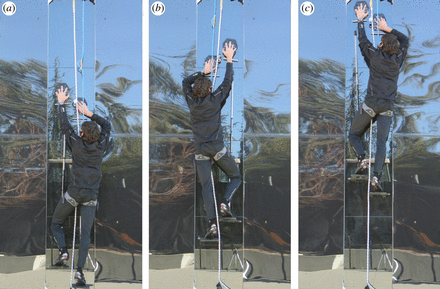
Spidey and van der Waals...

Figure 2 from the paper
Three frames from a video (electronic supplementary material, movie S1) showing a 70 kg climber ascending a 3.7 m vertical glass surface using a synthetic adhesion system with degressive load-sharing and gecko-inspired adhesives. The time between (a) and (c) is about 90 s and includes six steps.

Geckos, when not shilling for insurance companies, are most known for their climbing abilities that let them scale walls effortlessly. Thanks to their biology, geckos have one major advantage over humans who want to move vertically: they are small, and their bodies are light, so their natural adhesive just has to be good, not great. But a team of scientists from Stanford University’s Department of Mechanical Engineering have now one-upped the gecko, creating a hand-sized adhesive surface that allows humans to vertically scale glass walls.

I don't plan on rock climbing sheer faces of office buildings any time soon, but the fact they've figured this out (without the proverbial radioactive genetically enhanced spider) is pretty neat!

Popular Science:
Scale a Glass Wall With Gecko-Inspired Adhesive on Your Hands, Kelsey D. Atherton

Royal Society Publishing:
Human climbing with efficiently scaled gecko-inspired dry adhesives
Elliot W. Hawkes, Eric V. Eason, David L. Christensen, Mark R. Cutkosky

Wikipedia:
van der Waals Force
van der Waals Equation

Sunday, September 14, 2014

Home to Roost...


Newsflash: there are no major differences in the neoliberalism machinations of "no child's behind left" and "race to the bottom." Middle and high school teachers are tasked to "teach-to-the-test" (and told to lie they are not) if they want continued employment. With that coerced "foundation," it's no wonder today's college graduates are not developing the critical thinking skills and problem-solving acumen necessary for global competitiveness. We are all hostage to the testing-industrial-complex (TIC) that thinks once we've cajoled children in Pavlovian fashion to regurgitate answers, we'll still be the "shining city on a hill" of our own self-deluded mythology and design the next great invention. The faux controversies between evolution, the age of the universe and "intelligent design" only throws gasoline on a glowing funeral pyre that was once our country, and confuses the hell out of a lot of young people. Evidence shows others have moved on and advanced beyond our demented imaginations and fantasies.

Are science and religion doomed to eternal "warfare," or can they just get along? Philosophers, theologians, scientists, and atheists debate this subject endlessly (and often, angrily). We hear a lot less from economists on the matter, however. But in a recent paper, Princeton economist Roland Bénabou and two colleagues unveiled a surprising finding that would at least appear to bolster the "conflict" camp: Both across countries and also across US states, higher levels of religiosity are related to lower levels of scientific innovation.

"Places with higher levels of religiosity have lower rates of scientific and technical innovation, as measured by patents per capita," comments Bénabou. He adds that the pattern persists "when controlling for differences in income per capita, population, and rates of higher education."

That's the most salient finding from the paper by Bénabou and his colleagues, which uses an economic model to explore how scientific innovation, religiosity, and the power of the state interact to form different "regimes." The three kinds of regimes that they identify: a secular, European-style regime in which religion has very little policy influence and science garners great support; a repressive, theocratic regime in which the state and religion merge to suppress science; and a more intermediate, American-style regime in which religion and science both thrive, with the state supporting science and religions (mostly) trying to accommodate themselves to its findings.

Mother Jones: Study: Science and Religion Really Are Enemies After All,
Chris Mooney

Related book links:

Susan Jacoby (see video embed) - The Age of American Unreason:


"If a nation expects to be ignorant and free, in a state of civilization, it expects what never was and never will be." Thomas Jefferson, 1816

The three Great Premises of Idiot America, Charles P. Pierce:

· Any theory is valid if it sells books, soaks up ratings, or otherwise moves units
· Anything can be true if someone says it loudly enough
· Fact is that which enough people believe. Truth is determined by how fervently they believe it

Eric Fromm - Escape From Freedom:

If humanity cannot live with the dangers and responsibilities inherent in freedom, it will probably turn to authoritarianism. This is the central idea of Escape from Freedom, a landmark work by one of the most distinguished thinkers of our time, and a book that is as timely now as when first published in 1941. Few books have thrown such light upon the forces that shape modern society or penetrated so deeply into the causes of authoritarian systems. If the rise of democracy set some people free, at the same time it gave birth to a society in which the individual feels alienated and dehumanized. Using the insights of psychoanalysis as probing agents, Fromm’s work analyzes the illness of contemporary civilization as witnessed by its willingness to submit to totalitarian rule.

Tomorrow: Peace Dividend

Tuesday, August 26, 2014

The EmDrive That Wasn't...

The EmDrive produces propulsion without propellant, according to its inventor. (Credit: SPR, Ltd)
Physicist John Baez has another, more colorful word to describe the spate of recent reports about a breakthrough space engine that produces thrust without any propellant. The word starts with “bull–.” I won’t finish it, this being a family-friendly web site and all. Baez himself has softened his tone and now calls it “baloney,” though his sentiment remains the same: The laws of physics remain intact, and the “impossible” space drive is, as far as anyone can tell, actually impossible.

The story begins several years back with a British inventor named Roger Shawyer and his EmDrive, a prototype rocket engine which he claimed generated thrust by bouncing microwaves around in an enclosed metal funnel. Since no mass or energy emerged from the engine, Shawyer’s claim was another way of saying that he’d found a way to violate the conservation of momentum. In Baez’s words, “this is about as plausible as powering a spaceship by having the crew push on it from the inside.” Shawyer argued that he was exploiting a loophole within general relativity. Baez calls his explanation “mumbo jumbo.”

I'd read about the EmDrive, and didn't blog about it, thankfully. Something about it didn't "smell right," and it put me in the mind of the whole "cold fusion" boondoggle of the late 80's - early 90's. Plus, I ran into some links that gave a "404" error, which if you're trying to convince someone to fund your project is probably not a good sell! Surprisingly, a few courageous ones are still doing work in the area. As my Air Force JROTC instructor was apt to say to disavow responsibility or knowledge in any subject: "not the kid!"

This is not to be confused with warp drive. That science is actually being done painstakingly, and the reporting as accurate as possible. Meaning: as science goes, one must report the failures as well as the successes and subject your study to ruthless peer review. It's the science equivalent of a gauntlet at a bar fight. Even 1/10th the speed of light would be a significant accomplishment, and get us to at least Alpha Centauri in a human lifetime. It would at least reduce Mars to a matter of minutes (I'll leave space tourism to the visionary).

The author, Corey S. Powell, ends his article with an appropriate Latin metaphor. The rest of the article is at the link below:

"Ad astra per aspera: through hardship, to the stars."

Discovery: Did NASA Validate an “Impossible” Space Drive? In a Word, No.
Cory S. Powell

Sunday, July 20, 2014

M.A.D...

Image Source: KQED.org
Today is the 45th anniversary of the Apollo 11 moon landing. Despite what the naysayers and conspiracy theorists insist on with You Tube embed videos ad nauseum, I counter that with the memory of initially disappointed 6-year-old eyes as my Saturday cartoons had been preempted. Those eyes - mine - were soon delighted, sitting on my father's lap filled with wonder and hope. Post Dr. King's assassination, our continued involvement in the Vietnam conflict (of which I had several older friends fighting) and the turbulence of the 1960's, nationally we all needed a lift of our collective spirits.

2014: We appear to be losing it - spirit, mind, wonder...hope.

Ground forces advance in Gaza...The Malaysian airlines downed in the Ukraine...Fires raging in Washington State and drought in California...The border crisis of Central American refugees fleeing the drug wars and violence we helped foster...

Mutually Assured Destruction (M.A.D.): born when the former Soviet Union achieved parity with the US in nuclear weapons. The research of the weapons of our extinction was birthed during the Second World War, and the fear Nazi scientists would beat the Americans to the atomic bomb punch. Destructiveness became measured in "Hiroshima's": ~ 100,000 souls perished in a flash of nightmare, an instant of atomizing. We comforted, compensated and deluded ourselves with moribund, useless drills of "duck and cover." The follow-on "improvement" - thermonuclear bombs - generated the following gradients:
  • 1 November 1952 ("Mike" - US): 800 Hiroshima's.
  • 12 August 1953 ("Joe-4" - USSR): 30 Hiroshima's.
  • 1 March 1954 ("Bravo" - US): 1,300 Hiroshima's.
  • 23 November 1955 (No code name - USSR): 300 Hiroshima's.
  • No date given ("Behemoth" - USSR): 5,000 Hiroshima's.
Most US and Russian yields are around 30 Hiroshima's currently. (Source: "Black Holes and Time Warps-Einstein's Outrageous Legacy," Kip Thorne, pages 231-232, paperback).

Science and power

Unfortunately, it would be naive to say science has been strictly harnessed for the benefit of mankind. Part of the reason you have 3% of climate scientists "doubt" the conclusions of 97% of their colleagues on climate change is science costs money. Money comes from benefactors who typically have agendas; those being obviously amassing more power and wealth to themselves. A large part of the tools developed to analyse the density, mass and electric charge of black holes were developed during the Manhattan Project; many things we take for granted were developed initially for the Apollo program. This is called "spin-off": a peaceful commercial application to an otherwise warfare-born idea. The Internet is another example.

We are at a tinderbox moment of history. Our publicly elected political leaders parrot apocalyptic worldviews from the once extreme, now mainstreamed portions of society. Our motivations as a species must change if we are to solve difficult problems and survive our own hubris. Our current understanding of five previous mass extinction events makes our balance in the Drake Equation not look so favorably for us. The world will keep spinning, and it's instructive to note dinosaurs are "technically" still around us (counter to creationists' envision): as fossil fuels, lower reptiles and consumed chickens. J. Robert Oppenheimer - America's Prometheus - is an example of what happens when genius is employed in the service of sociopaths.

M.A.D. is the acronym of the unthinkable; the "doomsday scenario," the outcome succinctly summed in the 80's classic "War Games" and that life sadly, doesn't always conclude in the neatly-packaged Hollywood ending:

Sunday, June 15, 2014

Loss of the Commons...


According to Pew Research, we as an American Public are far more partisan/polarized than we've ever been. It affects who we live next to; where we shop and worship (or not); where our kids go to school; who we befriend/follow on social media. I think it affects how we take in knowledge, how we measure knowledge and what we count as knowledge.


Seen in some platforms as a link:

Saturday, June 14, 2014

My Name is Barry Allen...

The Global Dispatch
Dimensional barrier...unknown energies...antimatter...dark energy...x element (?)...I applaud their near Star Trek level techno-babble. Smiley

Though it mixes comic companies, he reminds me of Toby Maguire in the original Spiderman movies. Similar to Peter Parker's epic lunchroom fight with Flash Thompson, everyone moving in slow-mo; the look of sheer terror and befuddlement is entertaining when Barry Allen realizes he's not quite human anymore (or, as they allude, he's a meta-human).

Anyway, this post is reminiscent is when I encountered comic book characters, other than reading them in the comics. It would be on Saturday mornings, rising early at 6 AM, glued to the set until 3 PM ending with the Lone Ranger and Tonto. It's how I know the Apollo moon landing happened (when Jonny Quest reruns gets interrupted for Neil Armstrong, as a 6-year-old, you can get a little excited). I, of course, wasn't disappointed.

I hope you enjoy it in the fall. Along with Arrow, Gotham, Agents of Shield, the fall line up - minus "reality" television - should be fun (again).

Friday, June 13, 2014

Computational Anthropology...

Location-based social networks are allowing scientists to study the way human patterns of behaviour change in time and space, a technique that should eventually lead to deeper insights into the nature of society.

TECHNOLOGY REVIEW: The increasing availability of big data from mobile phones and location-based apps has triggered a revolution in the understanding of human mobility patterns. This data shows the ebb and flow of the daily commute in and out of cities, the pattern of travel around the world and even how disease can spread through cities via their transport systems.

So there is considerable interest in looking more closely at human mobility patterns to see just how well it can be predicted and how these predictions might be used in everything from disease control and city planning to traffic forecasting and location-based advertising.

Today we get an insight into the kind of detailed that is possible thanks to the work of Zimo Yang at Microsoft research in Beijing and a few pals. These guys start with the hypothesis that people who live in a city have a pattern of mobility that is significantly different from those who are merely visiting. By dividing travelers into locals and non-locals, their ability to predict where people are likely to visit dramatically improves.

Zimo and co begin with data from a Chinese location-based social network called Jiepang.com. This is similar to Foursquare in the US. It allows users to record the places they visit and to connect with friends at these locations and to find others with similar interests.

Physics arXiv: Indigenization of Urban Mobility
Zimo Yang, Nicholas Jing Yuan, Xing Xie, Defu Lian, Yong Rui, Tao Zhou